FeNigma
Fe (iron) + enigma, we solve the geometric puzzles.
A companion app that mostly automates **IRON NEST: Heavy Turret Simulator** for you. Select the game's typewriter orders (selecting text in-game copies it to your clipboard automatically) and it solves the geo puzzle and the trajectory math, handing you ready-to-fire commands: elevation, azimuth, number of powder charges. Screenshotting works the same way when a selection isn't practical. Select or screenshot the field log the same way and it picks up kills and newly-spotted units automatically. You can also plan strikes and scout flights of your own. Pure screen-reading, no game files touched, no input injected. 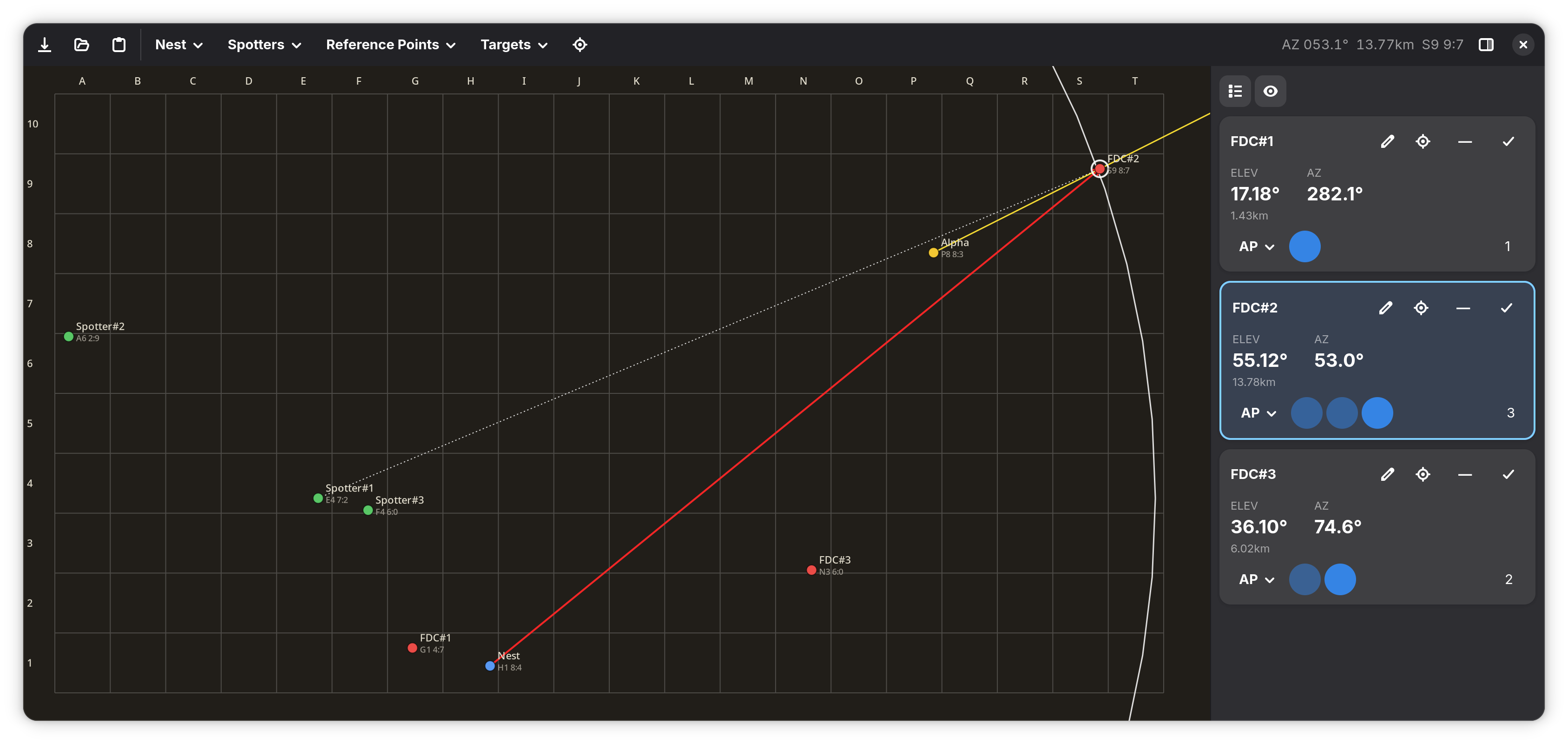 ## What it does - **Reads orders, solves the geometry.** Copy (or screenshot) the in-game typewriter text and it parses absolute grid refs and relative bearing/distance descriptions, then resolves everything into map coordinates, chained clues ("Bearing 293 from Alpha") included. The map shows its work: the actual bearing lines/circles behind each resolved position. When a description is genuinely ambiguous (two intersections), both candidates are shown instead of guessing. - **Calculates the shot.** Every resolved target gets a live firing card: elevation, azimuth, and minimum powder charge, computed from the Nest. - **Tracks the battle.** A second copy/screenshot of the field log marks units destroyed and folds in newly-spotted contacts, merging with what's already known instead of duplicating it. - **Plans strikes.** Drop a strike anywhere on the map and pick a shell to preview its blast radius before committing. - **Plans scout flights.** Click the map to plot a scout flight's sweep path: it anchors to the large grid square you're pointing at and reads the heading off exactly where in that square you click, previewed live before you commit. - **Watches the clipboard for you.** Toggle auto-watch and every new screenshot or copied intel text gets read and merged automatically, no manual fetch between orders. ## Install ```bash ./install.sh ``` Sets up a venv for the Python deps (Pillow, numpy, pytesseract) and checks for the system packages that pip can't install: GTK4/libadwaita bindings and tesseract. If either is missing it prints the package names for your distro and stops, install those and re-run. ## Run ```bash ./run.sh ``` Uses the venv from `install.sh` if one exists, otherwise falls back to system `python3`. GTK apps with this app ID are single-instance, if a run gets killed uncleanly it can leave a zombie registered on D-Bus and silently no-op the next launch. If `./run.sh` seems to do nothing, `pgrep -af fenigma` and kill any stragglers first. ## Tests ```bash pip install -r requirements-dev.txt pytest ``` Regression coverage for every intel-text format the OCR pipeline understands and the solver's geometry, in `tests/`. Run this before trusting a change to `ocr.py`/`solver.py`, several of the formats have collided with each other in non-obvious ways before. ## Stack GTK4 + libadwaita (PyGObject) for the UI, Tesseract (via pytesseract) for OCR, Pillow/numpy for preprocessing. Details on the coordinate system, OCR formats, and solver internals live in code comments (`solver.py`, `ocr.py`, `models.py`) rather than here.