 Dominik Roth
8c73442c03
Dominik Roth
8c73442c03
Circle-circle intersection (and the other solvable shapes) already worked correctly, verified with a direct test: two distance-only clues resolve to potential_coords whenever the two circles actually cross. What was missing was feedback when they don't, e.g. two distances that put one circle entirely inside the other given the references' real positions looks identical, from the dialog's perspective, to a reference that's just not placed yet. solver.explain_unresolved() distinguishes 'waiting on <ref> for a known position' from 'these two readings are geometrically inconsistent', wired into _apply_and_refresh's toast after a manual Description-tab edit. |
||
|---|---|---|
| src/fenigma | ||
| .gitignore | ||
| icon_alt.png | ||
| icon.png | ||
| install.sh | ||
| README.md | ||
| requirements.txt | ||
| run.sh | ||
| showcase.png | ||


FeNigma
Fe (iron) + enigma, we solve the geometric puzzles.
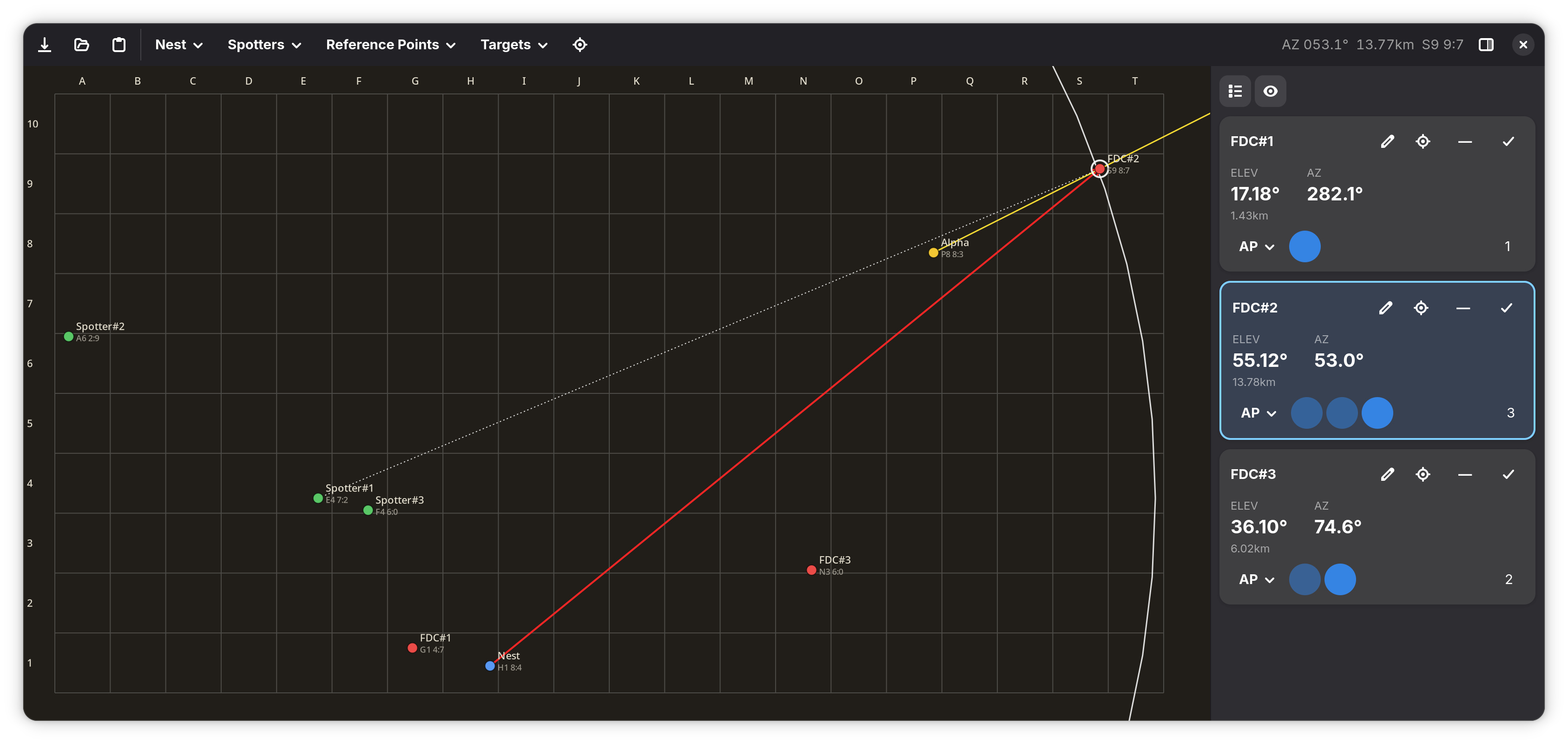
A companion app that mostly automates IRON NEST: Heavy Turret Simulator for you. Screenshot the game's typewriter orders and it solves the geo puzzle and the trajectory math, handing you ready-to-fire commands: elevation, azimuth, number of powder charges. Screenshot the field log and it picks up kills and newly-spotted units automatically. You can also plan strikes of your own, picking a shell for the blast radius you need. Pure screen-reading, no game files touched, no input injected.
What it does
- Reads orders, solves the geometry. Paste/screenshot the in-game typewriter text and it parses absolute grid refs and relative bearing/distance descriptions, then resolves everything into map coordinates, chained clues ("Bearing 293 from Alpha") included. The map shows its work: the actual bearing lines/circles behind each resolved position. When a description is genuinely ambiguous (two intersections), both candidates are shown instead of guessing.
- Calculates the shot. Every resolved target gets a live firing card: elevation, azimuth, and minimum powder charge, computed from the Nest.
- Tracks the battle. A second screenshot of the field log marks units destroyed and folds in newly-spotted contacts, merging with what's already known instead of duplicating it.
- Plans strikes. Drop a strike anywhere on the map and pick a shell to preview its blast radius before committing.
Install
./install.sh
Sets up a venv for the Python deps (Pillow, numpy, pytesseract) and checks for the system packages that pip can't install: GTK4/libadwaita bindings and tesseract. If either is missing it prints the package names for your distro and stops, install those and re-run.
Run
./run.sh
Uses the venv from install.sh if one exists, otherwise falls back to system python3. GTK apps with this app ID are single-instance, if a run gets killed uncleanly it can leave a zombie registered on D-Bus and silently no-op the next launch. If ./run.sh seems to do nothing, pgrep -af fenigma and kill any stragglers first.
Stack
GTK4 + libadwaita (PyGObject) for the UI, Tesseract (via pytesseract) for OCR, Pillow/numpy for preprocessing. Details on the coordinate system, OCR formats, and solver internals live in code comments (solver.py, ocr.py, models.py) rather than here.