 Dominik Roth
980be86908
Dominik Roth
980be86908
Previously two distance-only clues whose circles didn't actually intersect (real typewriter data isn't perfectly consistent, a misplaced spotter or an off-by-a-bit distance reading is enough) just gave up entirely, even when they were nearly touching. solver.closest_compromise_point() picks the midpoint between each circle's point facing the other, the standard notion of the closest approach between two circles. It stays well-behaved even when the centers are nearly coincident, unlike projecting along the center line the way a real intersection's formula does, which diverges as the centers get close while the radii stay far apart, exactly the near-coincident case this is for. The result is flagged rather than treated as a clean fix: Location gained a field, set whenever solve_location() had to use this fallback, cleared by any subsequent coord.setter call (manual or solver), shown in the entity's status label and toasted after a manual clue edit. Persisted through save/load. |
||
|---|---|---|
| src/fenigma | ||
| .gitignore | ||
| icon_alt.png | ||
| icon.png | ||
| install.sh | ||
| README.md | ||
| requirements.txt | ||
| run.sh | ||
| showcase.png | ||


FeNigma
Fe (iron) + enigma, we solve the geometric puzzles.
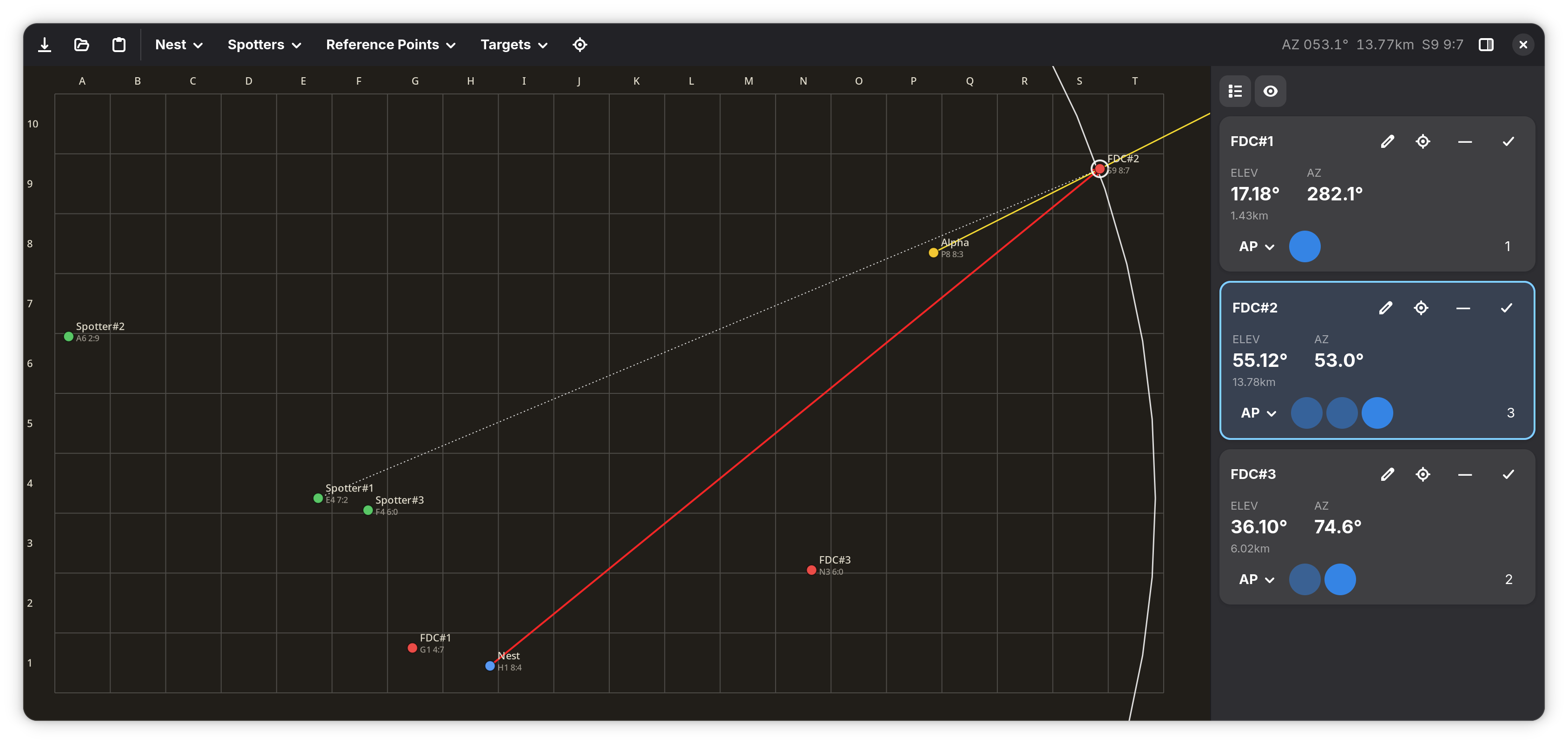
A companion app that mostly automates IRON NEST: Heavy Turret Simulator for you. Screenshot the game's typewriter orders and it solves the geo puzzle and the trajectory math, handing you ready-to-fire commands: elevation, azimuth, number of powder charges. Screenshot the field log and it picks up kills and newly-spotted units automatically. You can also plan strikes of your own, picking a shell for the blast radius you need. Pure screen-reading, no game files touched, no input injected.
What it does
- Reads orders, solves the geometry. Paste/screenshot the in-game typewriter text and it parses absolute grid refs and relative bearing/distance descriptions, then resolves everything into map coordinates, chained clues ("Bearing 293 from Alpha") included. The map shows its work: the actual bearing lines/circles behind each resolved position. When a description is genuinely ambiguous (two intersections), both candidates are shown instead of guessing.
- Calculates the shot. Every resolved target gets a live firing card: elevation, azimuth, and minimum powder charge, computed from the Nest.
- Tracks the battle. A second screenshot of the field log marks units destroyed and folds in newly-spotted contacts, merging with what's already known instead of duplicating it.
- Plans strikes. Drop a strike anywhere on the map and pick a shell to preview its blast radius before committing.
Install
./install.sh
Sets up a venv for the Python deps (Pillow, numpy, pytesseract) and checks for the system packages that pip can't install: GTK4/libadwaita bindings and tesseract. If either is missing it prints the package names for your distro and stops, install those and re-run.
Run
./run.sh
Uses the venv from install.sh if one exists, otherwise falls back to system python3. GTK apps with this app ID are single-instance, if a run gets killed uncleanly it can leave a zombie registered on D-Bus and silently no-op the next launch. If ./run.sh seems to do nothing, pgrep -af fenigma and kill any stragglers first.
Stack
GTK4 + libadwaita (PyGObject) for the UI, Tesseract (via pytesseract) for OCR, Pillow/numpy for preprocessing. Details on the coordinate system, OCR formats, and solver internals live in code comments (solver.py, ocr.py, models.py) rather than here.